https://pol.dingherself.com/handouts/philosophical-foudations-constitutional-design.htmlDing
Philosophical Foundations of Constitutional Design
Posted: Mon, Feb 23, 2026
Today
- Philosophical foundations of the American Revolution [30 min]
- The social contract basis of the American republic
- Slavery & the racial contract
- Comparative constitutional design [45 min]
- Victoria Woodhull
- Sun Yet-Sen
The so-/racial contract basis of the American republic
Passages to look at together:
- The end of government is derived from the state of nature: The Federalist no. 51 (James Madison), pp. 443–44
- Revolution is justified by appeal to the state of nature: The Declaration of Independence, pp. 431–32
- Also, reference of “merciless Indian savages,” p. 433
- “… are, and of right out to be … ,” p. 433
- Slavery in the U.S. Constitution:
- The Enumeration Clause, art. 1, § 2, cl. 3
- The Slave Trade Clause, art. 1, § 9, cl. 1
- The Fugitive Slave Clause, art. 4, § 2, cl. 3
Two interpretations:
- The Framers were inconsistent.
- The Framers were consistent (Mills). Dred Scott v. Sandford, 60 U.S. 393, 410–11 (1856).
Victoria Woodhull’s constitution
Woodhull’s congress
- Vastly expanded legislative power (also eugenics), art. 4, § 2, pp. 8–11
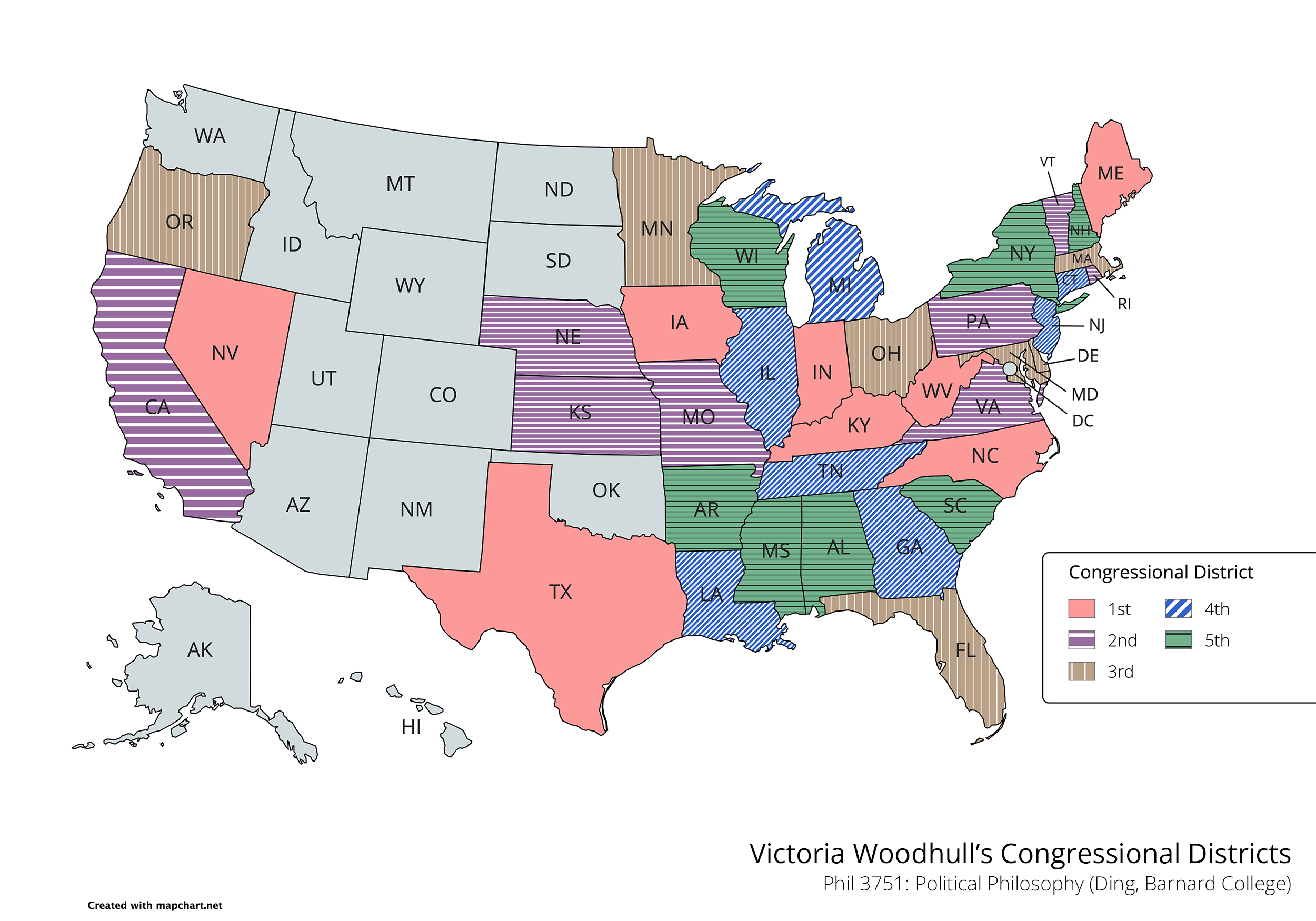
- At least one representative for every 100,000 people (~3,400 representatives).
- Bills must originate in the lower house.
- After the president signs a bill, it goes to the people for an up-or-down vote in the next general election.
- If the president vetos the bill, the lower house can override with a simple majority after reconsideration of the president’s reasons.
- With the people’s approval, the lower house may abolish the upper house with a three-fifth majority.
Woodhull’s congressional districts
Sun Yet-Sen’s constitution: Four powers of the people + five branches of government
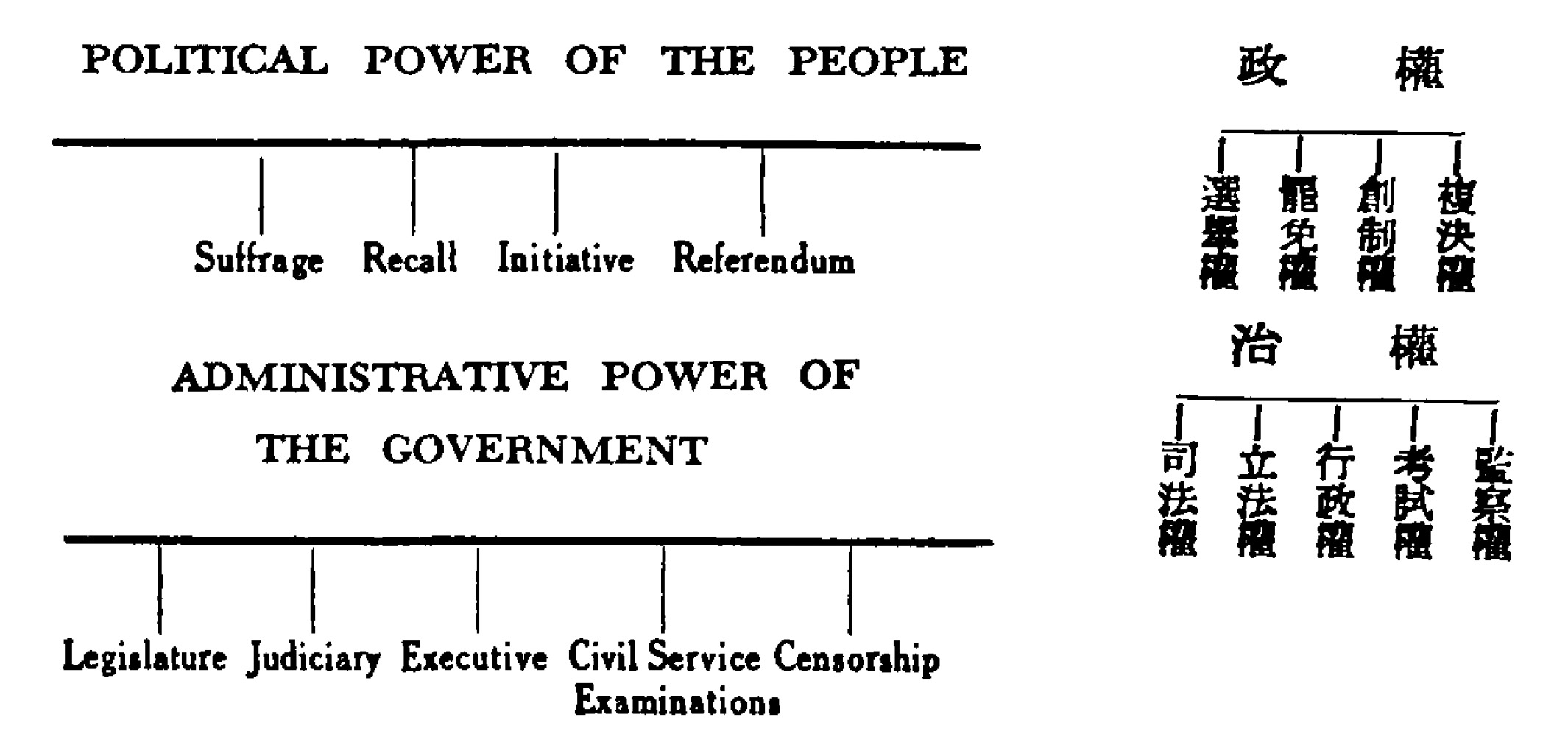
* “Censor” (監察) is probably better rendered as “audit,” “inspect,” or “supervision.”
In-class activity
Is Montesquieu right that “[i]t is in the nature of a republic to have only a small territory; otherwise, it can scarcely continue to exist”? (The Spirit of Laws, 8.16)?