https://pol.dingherself.com/handouts/wittig.htmlDing
Monique Wittig, The Straight Mind and Other Essays (1992)
Posted: Wed, Apr 15, 2026
Wittig’s “The Straight Mind”
- Presented at Barnard in 1979 as part of S&F VI.
- “Lesbians are not women” (p. 32).
My aims today
- I want to convince you that there’s something there.
- I want to use Wittig to introduce the “sex wars” as the next chapter in our survey of the making of contemporary political philosophy.
- The 1982 Barnard “sex conference”
- Women against Pornography
- I want to take another look at the Rawlsian project in light of Wittig’s critique.
- Screw your reasonableness
- Screw your neutrality on controversial metaphysics
- Screw your overlapping consensus
So far
Sex is taken for granted in political philosophy; it is always already there.
- Let’s start with a more or less standard sex/gender distinction: Gender is the social roles/norms/expectations associated with sex.
- Sex is always already there; gender is the cultural frosting layered on top of it.
- Sex is pre-social; it is not subject to political critique and cannot be unjust.
- Gender is political; it is subject to political critique and can be unjust.
- But how might gender be unjust? Social roles/norms/expectations are not inherently unjust.
- Well, social roles/norms/expectations can happen to be unjust if they fail to be justified by reality (sex)—they become mere stereotypes of sex.
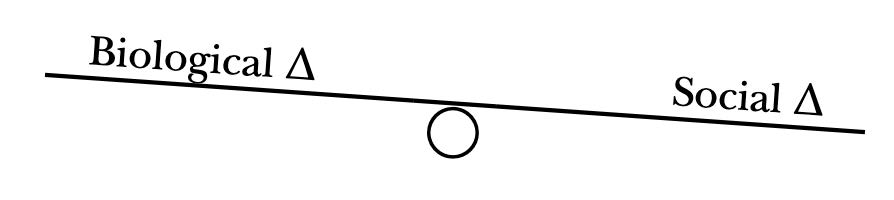
Problems:
- Oppression makes stereotypes into reality; sex stereotypes are rarely untrue.
- Sexist oppression so understood is an inequality between women and men; sexuality is not itself subject to political critique and cannot be unjust.
- We lack a philosophically interesting explanation of the origin of sex stereotypes.
Data points
- The term ‘sex’ refers to both sexuality and a system of categorization. Coincidence? No?
- If so much effort and so many carrots and stick are needed to make our society heterosexual, this suggests that heterosexuality is not so natural (which is why homosexuality needs to be so carefully guarded against).
- Sexuality has not always already been there. What’s sexual may not involve sex per se (e.g., non-genital body parts, power/violence), whereas sex need not be sexual (e.g., the lesbian sex that “doesn’t count”).
- “Having sex” does not have the same meaning for men and women. Men gain something by having sex; women lose something by having sex. “Getting fucked” is a bad thing; “fuck you” feels great. Women are “soiled” by sex; men are empowered by it. This is because sex is something men do to women.
- Compare: What feels feminine to women vs. what feels sexually desirable to men.
The radical/lesbian feminist analysis of sex
- Collapse the sex/gender distinction: “sex is already gendered, already constructed” (Butler).
- Reverse the explanatory relationship between gender and sexuality.
- Canonically, gender and sexuality are two distinct stories: You are a woman/man first, and then you get a sexuality depending on who you are attracted to.
- Wittig: Heterosexuality precedes and produces woman/man.
Key claim: The woman/man distinction does the ideological work of naturalizing, obscuring, and justifying sexist oppression.
- “Indeed the conventions and the language show on a dotted line the bulk of the social contract—which consists in living in heterosexuality. For to live in society is to live in heterosexuality. In fact, in my mind social contract and heterosexuality are two superimposable notions.” (p. 40).
- There are “biological differences” between the proletariat and the bourgeoisie (or between senators and citizens); but proletariat and bourgeoisie are political categories.
- Solution: “to overcome it one must destroy politically, philosophically, and symbolically the categories of ‘men’ and ‘women.’” (note: not biologically because not biological)
- Trying to reclaim woman (“women are beautiful”) is like trying to reclaim eunuchs (“eunuchs are beautiful”).